
Induction Stripping: How the Process Works
Induction stripping is an advanced coating removal process used on steel structures where control, safety, and efficiency matter. By heating the steel substrate directly using electromagnetic induction, coatings can be separated cleanly at the bond line—without abrasive media, excessive noise, or secondary waste.
The process is widely used in industrial environments to remove high-performance coatings while preserving steel integrity and minimizing disruption to surrounding operations.
What is Induction Coating Removal?
Induction coating removal relies on electromagnetic induction, a process in which an alternating electrical current generates a magnetic field that induces electrical currents, or eddy currents, within conductive materials such as carbon steel.
These eddy currents encounter electrical resistance within the steel which converts electrical energy into heat. This localized heat fails the bond between the substrate and the coating.
How Induction Heating Breaks Coating Bonds
Industrial coatings adhere to steel through a combination of mechanical interlock and chemical bonding. When the steel substrate is heated in a controlled manner, these adhesion mechanisms are disrupted.
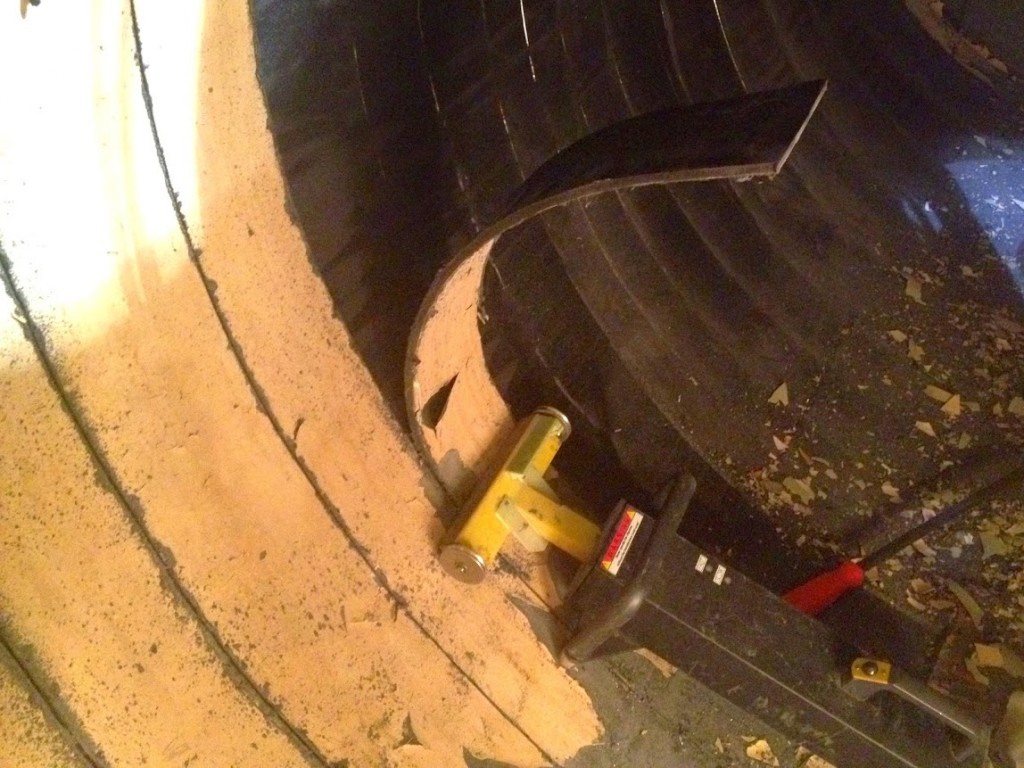
During induction heating, the steel expands more rapidly than the coating system. This differential thermal expansion places stress at the steel–coating interface, weakening adhesion and causing the bond to fail. In thicker or reinforced systems, the coating may crack or release in sections, allowing it to be lifted or mechanically removed with minimal force.
The objective of induction stripping is bond failure, not combustion or material degradation. Coatings are separated at the interface rather than burned, pulverized, or driven into the substrate.
Controlled Heat and Material Integrity
Induction stripping relies on controlled, localized heating rather than bulk temperature rise. Because heat is generated directly within the steel substrate, target temperatures can be reached quickly and allowed to dissipate just as fast once the induction field is removed.
This precise control allows the process to remain below thresholds that would affect steel metallurgy, mechanical properties, or weld integrity. When properly applied, induction heating does not alter base metal chemistry or structural performance.
Unlike open-flame or abrasive methods, induction stripping introduces no combustion, no kinetic impact, and no uncontrolled heat input. The result is a predictable, repeatable process that preserves substrate condition while enabling efficient coating removal.
How Induction Stripping Compares to Traditional Coating Removal Methods
Traditional coating removal methods rely on impact, abrasion, or material erosion. These approaches typically generate high noise levels, airborne particulate, and large volumes of secondary waste that must be contained and disposed of.
Induction stripping removes coatings by releasing the bond at the steel–coating interface rather than breaking the coating down mechanically. Because no abrasive media is introduced, secondary waste is limited primarily to the removed coating itself.
The process is significantly quieter than blasting or grinding and produces minimal airborne particulate. These characteristics make induction stripping well suited for storage tanks, lead abatement projects, and other controlled industrial environments.
Materials and Industrial Applications
Induction stripping is most commonly applied to carbon steel substrates in industrial environments where control, safety, and efficiency are critical. Because the process relies on electrical conductivity, it is particularly well suited for steel structures and components.
Typical applications include storage tanks, process vessels, pipelines, and structural steel. The method is frequently used to remove epoxy coatings, fiberglass-reinforced systems, rubber linings, and multi-layer industrial coating systems where traditional abrasive methods create excessive waste or operational disruption. It works particularly well on intumescent or PFP coatings.
Induction stripping is often selected for projects in active facilities, confined spaces, or environmentally sensitive areas where airborne particulate, noise, and secondary waste must be tightly controlled.